
01 /Engagement velocity: the heartbeat
How recently has the buyer side initiated contact? How quickly are they responding? Is the cadence accelerating or decaying?
Engagement velocity is the single best leading indicator of close. When it drops 30% week-over-week, the deal is in trouble — even if the rep doesn't feel it yet.
02 /Multi-threading depth: the resilience score
A deal with one championHealth · GlossaryChampionThe internal contact at a target account who actively advocates for your solution to the wider buying committee. Losing a champion mid-cycle is one of the strongest leading indicators of a deal slipping or dying outright.View full definition → is a deal one resignation away from death. AI tracks how many distinct stakeholders are engaged, at what seniority, and across which functions.
Single-threaded deals close at roughly half the rate of multi-threaded ones — a fact that AI can quantify and surface, deal by deal.
03 /Stage-fit and time-in-stage drift
Every healthy pipeline has a typical time-in-stage. AI compares each deal against that benchmark and flags the ones drifting beyond two standard deviations.
Deals that stall in 'Proposal' for 3x the team average aren't 'cooling' — they're statistically dead, and the score should reflect it.
04 /Deal shape: does it look like one you've won before?
AI compares the open deal to your closed-won history: industry, size, persona mix, source, sales cyclePipeline · GlossarySales Cycle LengthThe average number of days between deal creation (or first qualified meeting) and closed-won. A shorter sales cycle increases velocity, reduces cost-per-acquisition and shrinks the window in which deals can stall or be displaced by competitors.View full definition →. The closer the resemblance, the higher the structural probability.
This is where the ICP analysis and the deal score meet — and why they're more powerful together than apart.
05 /Reading the score like a pro
The number itself matters less than the breakdown. A 70 driven by strong engagement but weak multi-threadingHealth · GlossaryMulti-ThreadingThe practice of building active relationships with three or more buying-committee contacts inside a target account. Single-threaded deals (one champion only) are 3–4× more likely to slip when that contact leaves, goes silent, or loses internal political capital.View full definition → needs a different play than a 70 driven by deep multi-threading and weak engagement.
Leaders who learn to read the components — not just the headline — coach faster and forecast tighter.
D01 /Worked example: dissecting a 70/100 in detail
Imagine a £140k deal in 'Proposal' that is scoring 70. The headline number is reassuring. The breakdown is what changes the conversation. Engagement velocity contributes 22 of the 70 (strong — buyer is replying inside 24 hours, meeting cadence is weekly). Multi-threadingHealth · GlossaryMulti-ThreadingThe practice of building active relationships with three or more buying-committee contacts inside a target account. Single-threaded deals (one champion only) are 3–4× more likely to slip when that contact leaves, goes silent, or loses internal political capital.View full definition → depth contributes only 8 of a possible 20 (weak — one championHealth · GlossaryChampionThe internal contact at a target account who actively advocates for your solution to the wider buying committee. Losing a champion mid-cycle is one of the strongest leading indicators of a deal slipping or dying outright.View full definition →, no exec sponsor). Stage-fit contributes 18 of 20 (typical proposal duration). Deal shape contributes 22 of 30 (close fit to recent £100–200k closed-won deals).
That breakdown tells you exactly what to do this week: book an exec sponsor introduction. The headline 70 would have led to complacency. The component view leads to a specific play that lifts the score from 70 to 85 inside ten days — the difference between a likely close and an inevitable one.
D02 /The four bands every leader should know cold
Healthy (75–100): close-rate ≥ 70% in your historical cohort. Lock these in, don't over-invest. Monitor (50–74): close-rate 35–55%. This is where most coaching ROI lives — small interventions move the needle. At-Risk (25–49): close-rate 10–25%. Triage decision required: rescue with an exec sponsor, or remove from forecast and reclaim the rep's time.
Critical (0–24): close-rate under 10%. Stop forecasting these deals immediately. Counterintuitively, the cleanest signal of a healthy organisation is a forecast that excludes Critical deals entirely — even if the rep is still working them. Hope is not a forecasting input.
D03 /How the score interacts with rep judgement
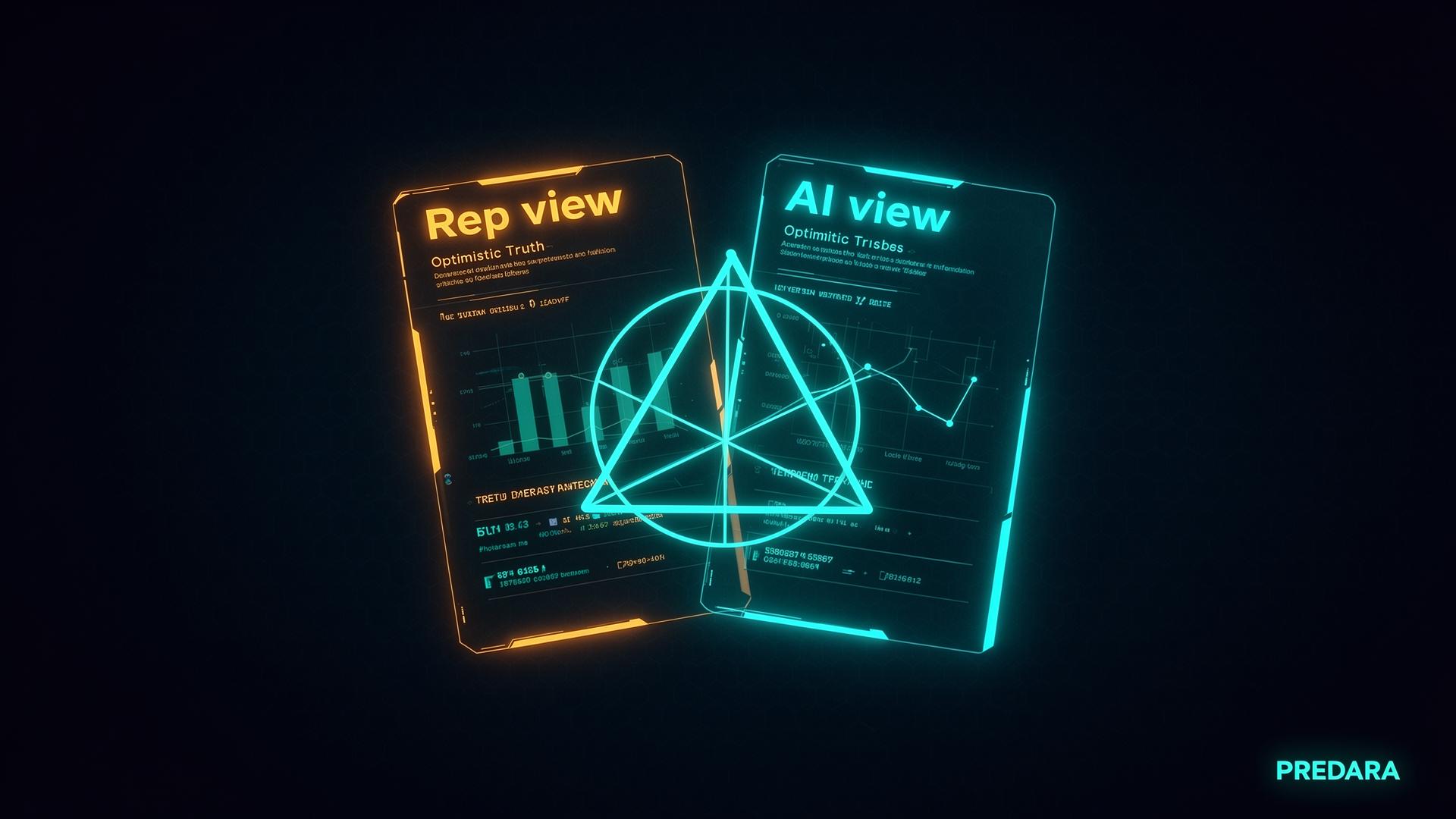
The biggest mistake leaders make is to treat the score as the answer. The score is the second opinion. The rep has context the model does not — the procurement contact who hates Mondays, the CFO who is about to be replaced, the legal team that just rejected a similar contract. Both perspectives matter.
The cleanest operating model is to inspect every deal where the rep call and the model disagree by more than 20 points. If the rep can articulate the missing context, trust the rep and adjust the forecast manually. If the rep is just optimistic, trust the model. Within two cycles, this discipline closes the gap because reps internalise the signals the model is reading.
D04 /Why component-level scores beat black-box AI
A score that just says '34/100' is unfalsifiable. Reps cannot push back. Coaches cannot coach. Boards cannot interrogate it. A score that breaks into engagement, structure, fit and time-in-stage gives every stakeholder a way to engage with the model — to argue with it, to learn from it, to override it when they have better information.
Explainability is not a 'nice to have' for AI in sales. It is the precondition for adoption. Tools that hide their reasoning get ignored within a quarter. Tools that show their working get used every day, by every rep, on every deal — which is the only way the value compounds.
Frequently asked questions
Don't trust a deal score until you can take it apart. Then trust it more than the rep.
Going deeper? The 2-week Predara Academy covers this live with peer feedback and instructor Q&A.
See cohorts →Share this article